
传奇故事
Two Chinese sailors rescued, 22 missing after Panama-flagged bulk carrier sinks off eastern India’s coast, operation still ongoing: embassy tells GT_我的网站

A |
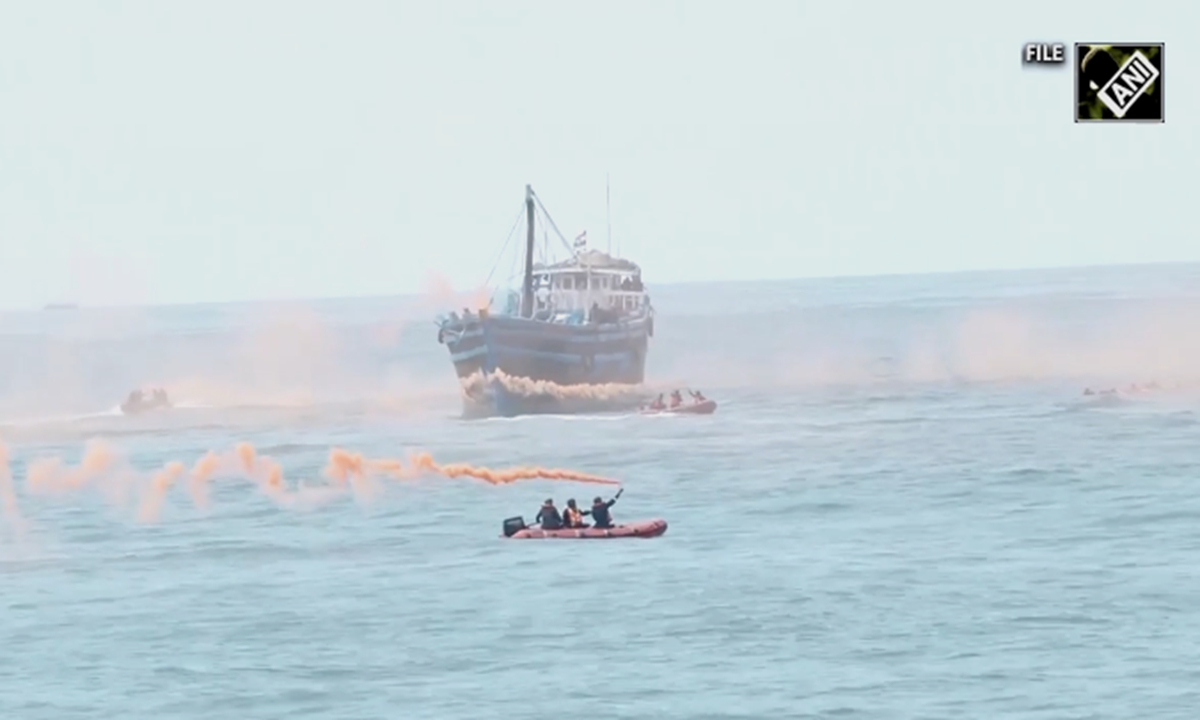
The two sailors were rescued from life rafts by MT Aisopos, a commercial vessel operating nearby, after an Indian Navy P-8I maritime surveillance aircraft located the rafts during the search-and-rescue mission, the Times of India reported.
The Chinese embassy in India told the Global Times that the rescue operation is still ongoing.
The two Chinese seafarers said the vessel, called Ocean Winner, had developed a list on Friday and sank within eight minutes, forcing the crew to abandon ship, Reuters reported, citing Shyam Jagannathan, director general of India's Maritime Administration.
Jagannathan said the chances of finding survivors generally fall sharply after the first 12 hours, but rescuers were continuing their search.
"All agencies are coordinating closely and actively doing search and rescue efforts," Sarbananda Sonowal, federal minister for India's Ministry of Ports, Shipping and Waterways, said in a social media post, according to Reuters.
India has experience and capabilities in maritime rescue operations in the Indian Ocean, and the practice is part of the country's international humanitarian responsibilities. Yet its active efforts to rescue the Chinese crew members could still leave a positive impression among Chinese people and allow the public to feel India's goodwill, which may improve China-India relations, Lin Minwang, deputy director of the Center for South Asian Studies at Fudan University, told the Global Times on Monday.
Having relevant officials continue to follow up on the rescue efforts and convey goodwill could further demonstrate India's willingness to improve ties with China, Lin said.
Ocean Winner, with IMO number 9145530, was a 70,000-deadweight-ton bulk carrier built in 1998. It loaded iron ore at Paradip and departed for Singapore on Thursday with 24 crew members aboard, according to Maritime Executive.
The vessel's Automatic Identification System signal disappeared in the middle of the Bay of Bengal at 4:45 pm GMT on Friday. The crew issued a distress alert at around the same time, the report said.
India has long sought the role of a security provider in the Indian Ocean and a major regional power. When maritime emergencies occur in the region, the Indian Navy and Coast Guard are capable of providing relatively timely assistance, Lin added.
The 22 missing crew members include 18 Chinese nationals, three Myanmar nationals and one Bangladeshi, according to the Indian Coast Guard.
Two Coast Guard vessels were dispatched from Sri Vijaya Puram, formerly known as Port Blair and the capital of India's Andaman and Nicobar Islands, to join the search-and-rescue operation, according to a Coast Guard spokesperson cited by Reuters.
Separately, Maritime Executive noted that iron ore fines can become hazardous when wet, as the cargo may liquefy and suddenly shift to one side while a vessel is rolling. This induces a list, accompanied by free surface effect, with serious adverse impact on stability. From 2007 to 2019, 29 seafarers were killed in casualties involving iron ore cargoes, the outlet reported.
。 CAPE TOWN, South Africa -- Angry protesters in Cape Town confronted the king and queen of the Netherlands on Friday as they visited a museum that traces part of their country’s 150-year involvement in slavery in South Africa.King Willem-Alexander and Queen Maxima were leaving the Slave Lodge building in central Cape Town when a small group of protesters representing South Africa's First Nations groups -- the earliest inhabitants of the region around Cape Town -- surrounded the royal couple and shouted slogans about Dutch colonizers stealing land from their ancestors.The king and queen were put into a car by security personnel and quickly driven away as some of the protesters, who were wearing traditional animal-skin dress, jostled with police.The Dutch colonized the southwestern part of South Africa in 1652 through the Dutch East India trading company. They controlled the Dutch Cape Colony for more than 150 years before British occupation. Modern-day South Africa still reflects that complicated Dutch history, most notably in the Afrikaans language, which is derived from Dutch and is widely spoken as an official language of the country, including by First Nations descendants.King Willem-Alexander and Queen Maxima made no speeches during their visit to the Slave Lodge but spent time walking through rooms where slaves were kept under Dutch colonial rule. The Slave Lodge was built in 1679, making it one of the oldest buildings in Cape Town. It was used to keep slaves -- men, women and children -- until 1811. Slavery in South Africa was abolished by the English colonizers in 1834.Garth Erasmus, a First Nations representative who accompanied the king and queen on their walk through the Slave Lodge, said their visit should serve to “exorcise some ghosts.”The Dutch East India Company established Cape Town as a settlement for trading ships to pick up supplies on their way to and from Asia. Slaves were brought to work at the colony from Asian and other African countries, but First Nations inhabitants of South Africa were also enslaved and forced off their land. Historians estimate there were nearly 40,000 slaves in the Cape Colony when slavery ended.First Nations groups have often lobbied the South African government to recognize their historic oppression. They say their story has largely been forgotten in South Africa, which instead is often defined by the apartheid era of brutal forced racial segregation that was in place between 1948 and 1994.First Nations people have a different ethnic background from South Africa's Black majority.___AP Africa news: https://apnews.com/hub/africa。
Current article:http://www.zhouangnaoguangsundianzhenmou.cfd/3d3c/hvkrm69.html
Published on:11:28:33
胡雪岩_Random reading
- 08-24一山青绿 林下生金——陕西林下多元业态激活生态富民新动能,一山青绿 林下生金——陕西林下多元业态激活生态富民新动能
- 08-22手机数码国补继续申领!国补政策2026年最新消息:新一轮第三批买手机平板电脑3C数码国补15%+京东开学季校园教育优惠活动,学生换新时机到了!
- 08-20China City Talk: How Shanghai is turning public spaces, technology and social care into everyday services
- 08-20全民健身与奥运同行 全民健身系列活动鸣枪开跑
- 08-21为“绿水青山”装上数字引擎
- 08-26《塞尔达传说:时之笛 重制版》发售日泄露!零售商提前上架
- 08-26或将定名速腾L/有望三季度上市 曝全新一代一汽-大众速腾更多信息
- 08-26Pawan Kalyan's Ustaad Bhagat Singh Set for First Single Launch
- 08-252018年第一批“马云村教师奖”获奖者
- 08-24台风“紫檀”持续影响华南沿海 北方多地清凉上线

武林外传_Active users
- 中瑞自贸协定完成升级谈判:标注开放合作新刻度,中瑞自贸协定完成升级谈判:标注开放合作新刻度
- Cloudflare 称 AI 智能体已占 60% 互联网流量,同比激增 1700%
- The Color of Death: Legacy of Agent Orange Still Plagues Vietnam After Decades of Peace
- 手机家电国补申领指南|8月购买空调电脑手机如何参与国补?京东学生认证流程及补贴领取方法
- 索尼A6400外国媒体曝光:一款经济型4K反向自由摄像机,适合视频博客。
- 微博转发、评论数据调整:当数量超过100万时,显示为“100万”
- 父母在旁,防骗技能“重”新讲
- 【观点】南华期货:白糖上方压力明显,短期回调为主
- 把金石文脉搬上“云端” 杭州将新添一座“线上文化广场” “西泠网拍”平台本周六正式上线
- 辐射 4 发布补丁更新 Creation Kit,修复 Steam Deck 崩溃等各类问题
- Hours After Claiming He Was Buying Man Utd, Elon Musk Comes Out With Clarification
- Macaron-V1:RL,让 GLM5.2 再次伟大
- 东亚杯中国女足首战告捷
- 河北加速布局大数据中心体系
- Waymo将在德国慕尼黑启动自动驾驶测试,计划明年底前正式上线出行服务
- 水利部:去年全国水土流失面积267万平方公里,少于十年前_宋承翰_姚文
- 富达加码黄金押注美联储信誉危机与美元避险地位下滑
- 亚洲杯中国男排轻取巴基斯坦男排
一呼百应_Hottest this week
- 08-21Russia trying to 'kill' Starlink in Ukraine: Elon Musk
- 08-24Joran van der Sloot pleads guilty to extortion, provides details of Natalee Holloway's death
- 08-25罗永浩当场解释了为什么子弹短信改为“超宝”:子弹敏感,短信收费
- 08-20홈플러스, '홈플 is Back' 3차 특가…한우·한돈 최대 50% 할인
- 08-22男子百米大战,美国选手包揽前三
- 08-21抢车终极战提前爆火!萨巴提前相中梦中情车,奥胖自信能胜任何人
- 08-26手搓电影《目不转睛》将上映!导演放话票房破亿送粉丝10台宝马
- 08-25兴城八届市委常委会召开第一百五十次会议
- 传奇故事 copyright
- Some of the content comes from the Internet. If you have any offence, please raise it.