纸牌屋
Antarctic ice sheet loss temporarily slows due to remote influence of tropical warm pool: Chinese, foreign scientists_我的网站

A |
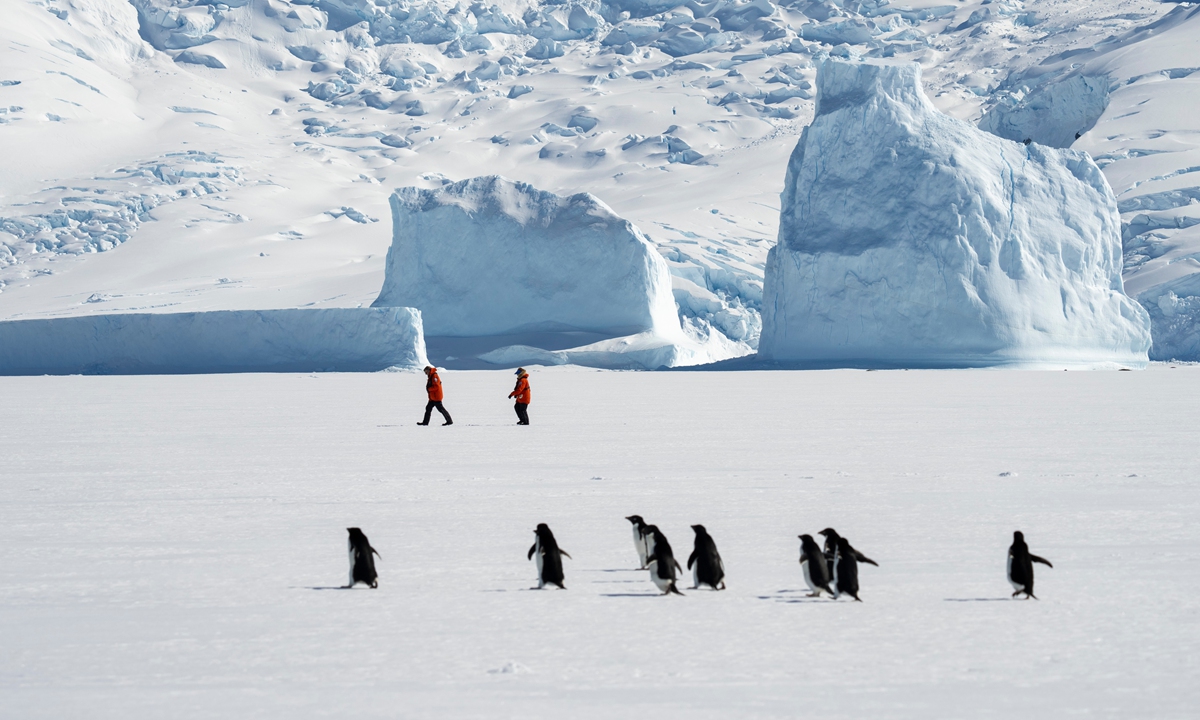
Joint research by Chinese and international scientists have found that the rate of long-term Antarctic mass loss has slowed, driven by sea surface temperature anomalies in the remote tropical warm pool, China Central Television (CCTV) reported on Thursday, citing a statement released by the Institute of Oceanology, Chinese Academy of Sciences (CAS).
The Antarctic ice sheet is one of the major sources of uncertainty in global sea-level rise forecasts. From 2003 to 2024, the Antarctic ice sheet lost an average of approximately 140.5 billion tons each year, CCTV reported.
However, Chinese and foreign scientists have found that the Antarctic ice sheet gained roughly 695 billion tons between July 2021 and April 2023, the largest 22-month mass gain seen in nearly two decades via satellite gravimetry, the Institute of Oceanology, CAS announced on Thursday.
The scientists found out that from 2021 to 2023, sustained heavy snowfall in East Antarctica led to significant increases in snow accumulation, partially offsetting the ongoing ice loss in West Antarctica.
The scientists' research shows that this was caused by tropical ocean-driven atmospheric processes that altered moisture transport pathways and increased snowfall over Antarctica.
The research was conducted by the research team at the Institute of Oceanology at CAS, along with peers from countries including the US, Hungary and Japan. It was published in the academic journal Nature on Wednesday.
According to Wang Yunhe, first author of the research paper and an associate research fellow at the Institute of Oceanology, sea surface temperatures in the tropical western Pacific warm pool remained unusually warm from 2021 to 2023. As one of the regions with the highest sea surface temperatures and strongest heat release into the atmosphere worldwide, changes in this region can reshape atmospheric circulation.
The persistently warmer-than-normal seawater triggered large-scale atmospheric waves.
After reaching the high latitudes of the Southern Hemisphere, the waves reshaped wind patterns and moisture transport pathways. Moisture-tracking simulations show that water vapor from the mid-latitude Indian Ocean fueled heavy snowfall in East Antarctica, leading to a recovery in ice sheet mass.
Observations and climate simulations suggest that such warming events occur roughly once a decade. But these temporary pauses are not enough to reverse Antarctica's long-term ice loss. The West Antarctic ice sheet continues to shrink, while parts of East Antarctica remain increasingly vulnerable to warmer ocean waters melting ice shelves from below and speeding the flow of glaciers into the sea.
The study shows how persistent warming in the tropical warm pool can contribute to the recovery of Antarctic ice-sheet mass, highlighting the role of East Antarctic atmospheric circulation in connecting tropical climate shifts with changes in the ice sheet. The findings point to a previously overlooked climate link between the tropical warm pool and East Antarctica, offering a new perspective on how distant climate systems may shape the continent's future.
Global Times
。

For the first time in the 64-year history of the awards, this year's edition introduced an AI-generated content (AIGC) recommendation unit, giving AI-generated films a new pathway into a major film award platform.
The move reflects a broader shift in the relationship between technology and cinema.
Rather than replacing filmmakers, AI is increasingly seen as a creative tool that lowers production barriers, expands visual possibilities and allows more people to turn ideas into films, Zhang Peng, an associate professor at Nanjing Normal University, told the Global Times.
The AIGC recommendation unit, launched on June 30, attracted 2,038 entries from around the world in just over a month. After evaluation, six productions received the "Hundred Flowers AIGC Recommendation Honor," covering categories including animation, visual effects, technology, creativity, directing and short films.
For many young filmmakers, AI has opened a new path into the industry. Multiple award-winning creators said at a seminar on the sidelines of the Hundred Flowers Awards that AI tools such as Jimeng and the Seedance model helped them with visual development, shot design, dubbing and maintaining emotional continuity.
Zhang Bohang, a representative of the team behind Yi Meng (A Dream), which won the award for Best Animated Work, said at the seminar that animation had long been a dream for the team, but high production costs had previously made it difficult to bring that dream to life. "The emergence of AI has given us a way to make our dreams come true," he said.
Lu Qiwei, a representative of the creative team behind Yecha Crossing the River, which won the Best Creative Work award, said at the seminar that Seedance allows creators to input characters, scenes, visual styles and directorial ideas, then select and organize the generated material themselves.
However, filmmakers at the event also emphasized that AI does not replace human creativity. Director Liu Shuheng, whose work Out of Control received recognition, said AI had lowered the threshold for creating visual images while raising the expectations for creators' decisions.
"AI makes it easier to create a picture, but it also makes people think more about why they choose to shoot it this way," Liu said at the seminar.
The shift is not limited to AI-powered filmmaking. The awards are also expanding recognition for emerging forms of storytelling.
The 38th Hundred Flowers Awards also introduced a new short-drama recognition section, marking the first time the awards had recognized short dramas. It marked the first time the awards had included short dramas in their recognition system, organizers said.
AI also featured prominently in the event's audience experience. Global Times reporters observed interactive installations that allowed audiences and celebrities to generate personalized digital keepsake photos, while AI was also used during the red-carpet livestream to provide real-time commentary, answer viewer questions and enhance visual backgrounds.
The Hundred Flowers Awards' embrace of AIGC comes as major Chinese film festivals increasingly explore AI's role in cinema.
Since its launch in 2024, the Beijing International Film Festival's AIGC Film Section has been the first dedicated section at a major film festival worldwide to focus on AI-powered image-making. Meanwhile, the Shanghai International Film Festival this year has launched a new "AI Studio" section, aiming to create the first experimental platform dedicated to exploring AI-assisted collaboration in film production.
From competition entries to audience experiences, these developments suggest that AI is no longer just a behind-the-scenes production tool, said Zhang.
"AI is gradually moving beyond being a filmmaking tool and becoming part of the broader film festival ecosystem," Zhang noted.
"From AI-generated films to short dramas, the move also shows how China's mainstream film platforms are embracing emerging formats and recognizing new forms of storytelling."
。
Current article:http://www.zhouangnaoguangsundianzhenmou.cfd/64459/yri.html
Published on:12:26:29


